Lieferung in ganz Europa




Rita Brandes
Antwortet in der Regel innerhalb weniger Minuten
Hallo zusammen...
Wie können wir Ihnen helfen?

Maltodextrin or dextrose? A manufacturer’s comparison of sweetness, hygroscopicity, browning, fermentability and typical applications.
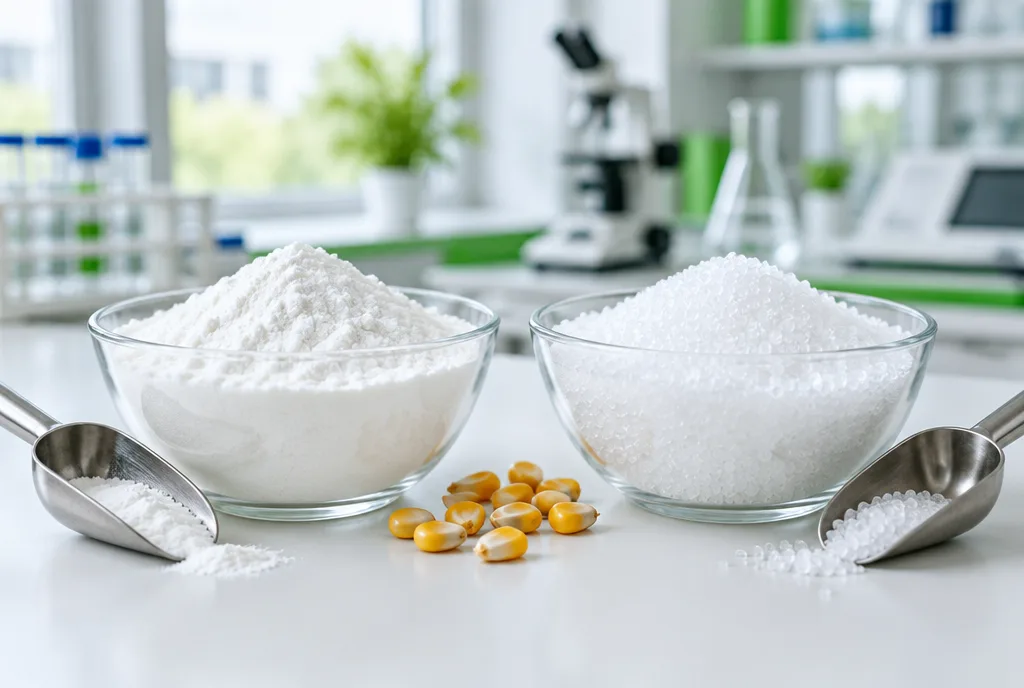
Maltodextrin and dextrose are both made from starch, both appear on countless ingredient lists, and both are supplied as white, free-flowing powders. For formulators and buyers, however, they behave very differently in production. This guide compares the two from a manufacturer’s point of view: functionality, processing and typical applications.
Traubenzucker is glucose, a single sugar molecule obtained by complete hydrolysis of starch. Maltodextrin is the result of partial hydrolysis: a mixture of glucose chains of different lengths. How far the starch has been broken down is expressed by the DE value (dextrose equivalent). Dextrose has a DE of about 100, maltodextrins typically range from DE 10 to DE 20, and dried glucose syrups from about DE 20 upwards.
| Maltodextrin (DE 10–19) | Traubenzucker | |
|---|---|---|
| Sweetness | Low, almost neutral | Clearly sweet |
| Hygroscopicity | Low to moderate | Higher |
| Body and viscosity | Adds body and mouthfeel | Little body |
| Maillard browning | Low | Hoch |
| Fermentability | Limited | Readily fermentable |
| Typical role | Bulking agent, carrier, texturiser, binder | Sweetener, fermentation substrate, browning agent |
biolla chemicals liefert Maltodextrin DE 10–25 und Dextrose (Monohydrat und wasserfrei) aus Hamburg an Lebensmittel-, Nahrungsergänzungs- und Pharmahersteller in ganz Europa. Spezifikation, CoA und Muster auf Anfrage.
Maltodextrin anfragenDextrose anfragen
Oder direkt Kontakt aufnehmen: Kontaktformular - info@biolla.de · +49 40 67 555 155
Many recipes combine the two: maltodextrin for body, carrier function and process stability, dextrose for sweetness and browning. Adjusting the ratio, or switching to a different maltodextrin DE, lets formulators fine-tune sweetness, viscosity and drying behaviour without changing the overall carbohydrate content.
Usually not. Maltodextrin is much less sweet, browns less and behaves differently in fermentation. Test batches are needed to adjust the recipe.
The higher the DE, the closer the behaviour to dextrose. Maltodextrin DE 19 and dried glucose syrups DE 30 or DE 38 sit between classic maltodextrin and dextrose.
biolla chemicals liefert maltodextrin DE 10, 15, 19 and 25 (Ph. Eur., Kosher, Halal, non-GMO, 25 kg bags, DE 19 from stock) as well as dextrose monohydrate und dextrose anhydrous to manufacturers across Europe. Kontakt oder rufen Sie +49 40 67 555 155 an, um ein Angebot zu erhalten.