Lieferung in ganz Europa





Rita Brandes
Antwortet in der Regel innerhalb weniger Minuten
Hallo zusammen...
Wie können wir Ihnen helfen?

Warum Magnesiumstearat in Vitamintabletten und -kapseln eingesetzt wird, wie viel man braucht (0,25–1 %), wie man Überschmierung vermeidet und worauf es bei veganer, palmölfreier Qualität ankommt.
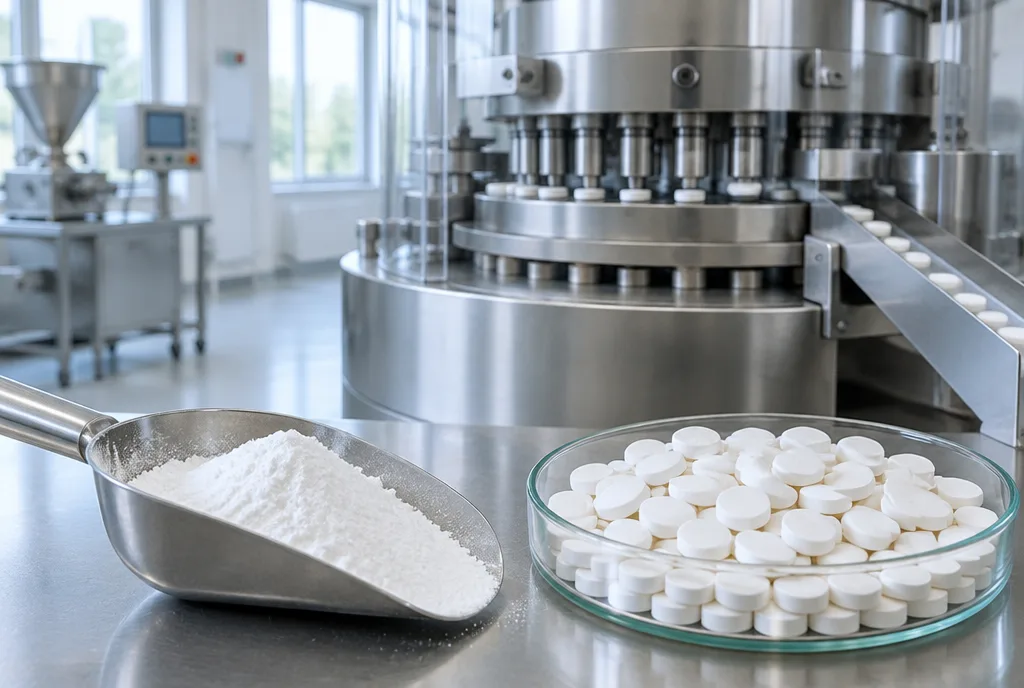
Almost every vitamin tablet and capsule produced in Europe contains a small amount of one excipient that is easy to overlook: Magnesiumstearat (CAS 557-04-0, E470b). It usually makes up less than one percent of the formulation, yet it decides whether a tablet press runs smoothly or stops every few minutes. This article explains why magnesium stearate is used in vitamin tablets and capsules, how much you need, which mistakes to avoid and what to look for when choosing a quality and a supplier.
Magnesium stearate is a lubricant. During compression, the powder blend is pressed in a die and then ejected. Without lubrication, the powder sticks to punches and die walls, ejection forces rise, tablets show defects such as capping or sticking, and the press has to be stopped for cleaning. A thin film of magnesium stearate on the particles reduces this friction. In capsule filling it works the same way: it helps the powder flow and keeps dosing discs and tamping pins clean.
In most tablet formulations, magnesium stearate is used at about 0.25 to 1.0% of the total blend, often around 0.5%. The right level depends on the formulation, the tablet size and the press. More is not better: the aim is the lowest level at which the press runs reliably.
Magnesium stearate is hydrophobic. If too much is used, or if it is blended for too long, it coats the particles completely. The results can be softer tablets und slower disintegration and dissolution. Practical rules that help:
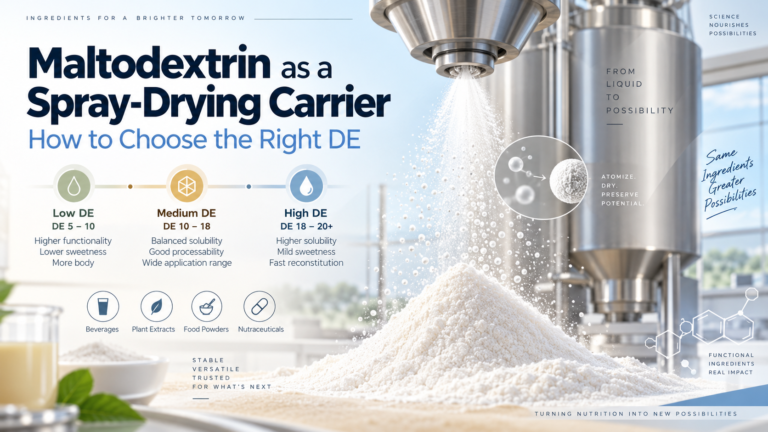
In direct compression, magnesium stearate almost always works together with a filler-binder such as microcrystalline cellulose (MCC 101 / MCC 102). MCC gives the tablet its strength; magnesium stearate makes sure it can be pressed and ejected without problems. Because MCC is sensitive to over-lubrication, the blending time for the lubricant is especially important in MCC-based vitamin tablets. For carrier and filler functions in powders and sachets, Maltodextrin is another common choice.
Magnesium stearate is made from stearic acid, which can come from animal or vegetable fats. Many supplement brands now require a vegetable, vegan source, and more and more also ask for palm oil-free raw materials. When you qualify a supplier, ask for confirmation of origin, vegan status and the pharmacopoeia grade (USP / BP / EP).
biolla chemicals liefert vegan, palm oil-free magnesium stearate in USP / BP / EP quality in 15 kg sacks, together with MCC, maltodextrin and a wide range of Vitamine – from crystalline B vitamins to vitamin D3 and K2 – to manufacturers across Europe. Send us your quantity and delivery address via our Kontaktformular, per E-Mail an info@biolla.de oder telefonisch unter +49 40 67 555 155.