Livraison dans toute l’Europe





Rita Brandes
Répond généralement en quelques minutes
Bonjour à tous...
Comment pouvons-nous vous aider ?

Where sorbitol powder E420 is used, how it differs from sorbitol solution 70% and what to check when buying it for gum, confectionery and tablets.
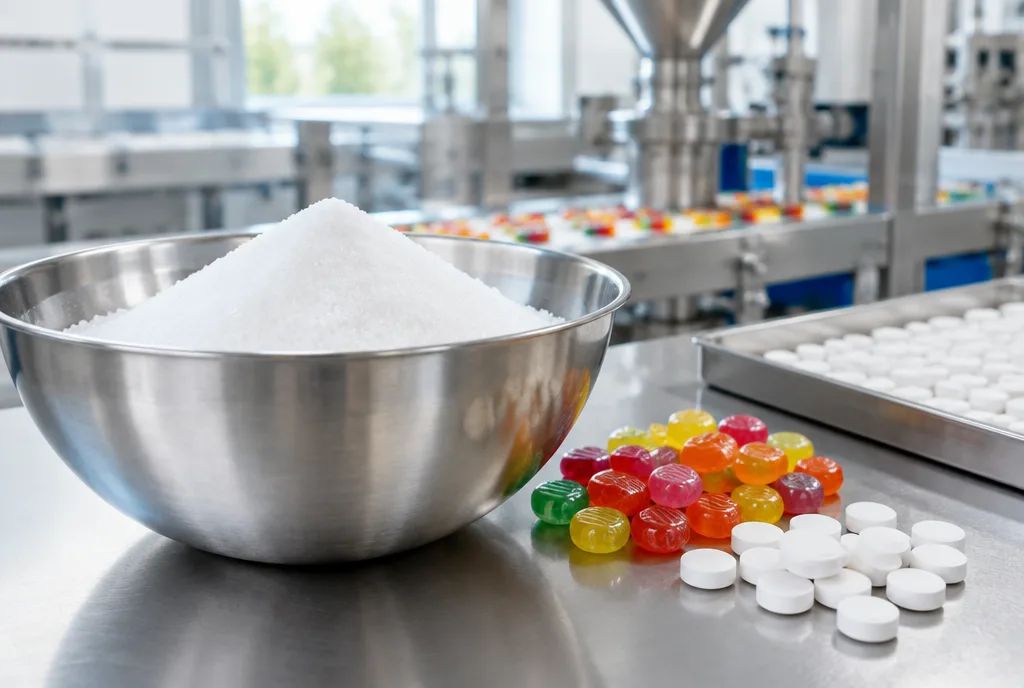
Sorbitol powder is one of the most widely used polyols in sugar-free products. Chewing gum, hard and soft confectionery, chewable tablets and powder blends all use it as a sweetener, bulking agent and carrier. But sorbitol powder is not simply “dry sorbitol syrup” – it behaves differently in production and needs its own handling. This guide explains where du sorbitol en poudre (E420, CAS 50-70-4) is used, how it compares with sorbitol solution 70%, and what buyers and formulators should check before choosing a supplier.
Sorbitol is a sugar alcohol (polyol) produced by hydrogenation of glucose. It is available in two main forms: as an aqueous solution, typically with 70% sorbitol, and as a crystalline powder. In the EU it is approved as a food additive under the number E420 and is used as a sweetener, humectant, bulking agent and stabiliser.
Sorbitol has roughly 60% of the sweetness of sucrose and a clean, mild taste. Because it dissolves with a negative heat of solution, it gives a pleasant cooling sensation in the mouth – one reason why it is popular in mint products and chewing gum.
Both forms contain the same molecule, but they are used at different points in production:
| Sorbitol powder | Sorbitol solution 70% | |
|---|---|---|
| Forme | Poudre cristalline blanche | Clear, viscous liquid |
| Utilisation typique | Chewing gum, tablets, compressed confectionery, dry blends | Toothpaste, syrups, soft confectionery, bakery, humectant applications |
| Fonction principale | Bulking agent, sweetener, tablet filler, carrier | Humectant, sweetener, texture and moisture control |
| Manipulation | Dosed as a dry ingredient, must be kept dry | Pumped and dosed as a liquid |
| Packaging at biolla | Sacs de 25 kg | IBC de 1 100 kg |
The rule of thumb: when the product is dry, compressed or must stay free-flowing, choose the powder. When water is part of the recipe anyway, or moisture retention is the main goal, the solution is usually easier to process. You can read more about the liquid grade in our article Sorbitol 70% in toothpaste.
In tablet production, sorbitol powder combines sweetness with good compressibility. Grades with a suitable particle size can be used in direct compression together with other excipients such as cellulose microcristalline and a lubricant like stéarate de magnésium. Important points for formulators:
Because sorbitol powder absorbs moisture from the air, correct storage is essential for consistent processing:
Foods containing more than 10% added polyols must carry the statement “excessive consumption may produce laxative effects” according to Regulation (EU) No 1169/2011. Formulators should take this into account when planning the polyol content of a new product.
Not directly. Sorbitol has around 60% of the sweetness of sucrose and different physical properties, so recipes usually need adjustment – for example in sweetness, texture or processing temperature.
Sorbitol is hygroscopic. If it is exposed to humid air, the particles absorb water and stick together. Dry storage and tightly closed packaging prevent this.
Sugar-free chewing gum mainly uses sorbitol powder as bulk sweetener and dusting agent; the liquid form is sometimes added in smaller amounts to adjust softness.
biolla chemicals fournit sorbitol powder E420 in 25 kg bags and solution de sorbitol 70 % in IBCs of 1,100 kg to food, confectionery and pharmaceutical manufacturers across Europe. Specification, CoA, SDS and samples are available on request. Send us your quantity and delivery address via our formulaire de contact, par e-mail à info@biolla.de ou par téléphone au +49 40 67 555 155.