Delivery across Europe





Rita Brandes
Typically responds within a few minutes
Hey there...
How can we help you?

Why specific surface area and particle size of magnesium stearate affect lubrication, tablet hardness and disintegration – and what to check on the Ph. Eur. specification.
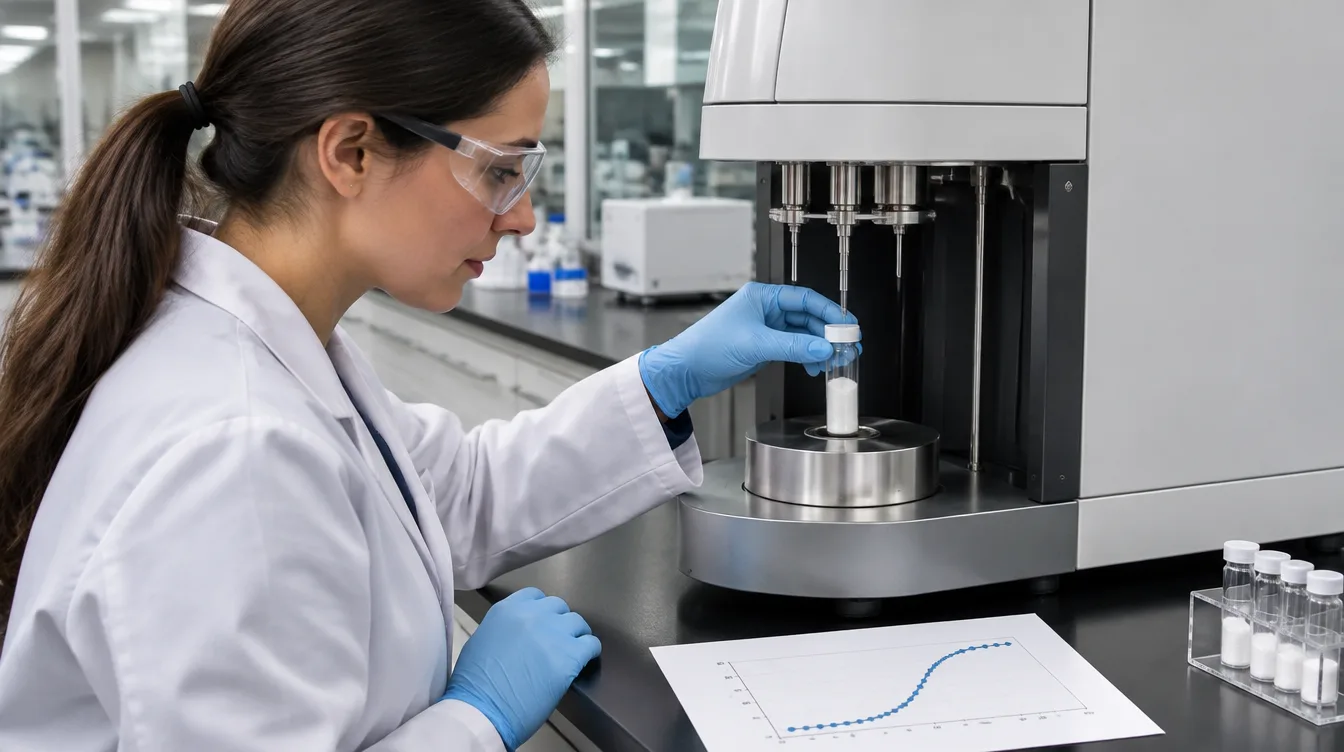
Magnesium stearate specific surface area is one of the least understood values on a specification, yet it often explains why two batches that both comply with Ph. Eur. behave differently on the tablet press. Together with particle size, the specific surface area decides how quickly magnesium stearate coats the other particles in a blend, how strong the lubricating effect is and how much it can soften tablets or slow down disintegration. This guide explains both parameters and what formulators and buyers should check.
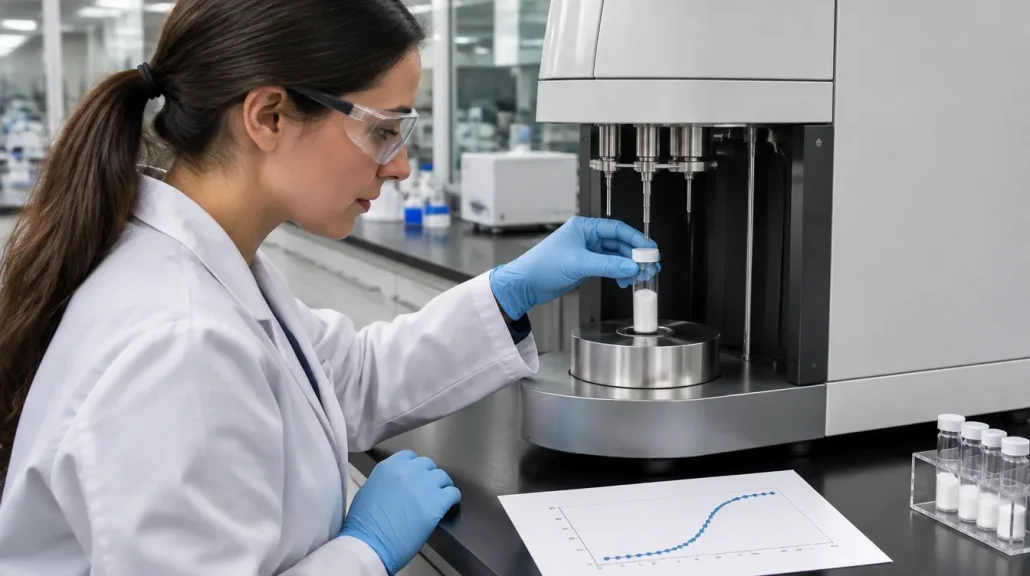
The specific surface area (SSA) is the total surface of the particles in one gram of powder, usually given in m²/g and measured by gas adsorption (BET method). Magnesium stearate consists of very thin, plate-like particles. The finer and thinner these particles are, the larger the surface area and the more easily they spread over the surface of other particles during blending.
The Ph. Eur. monograph lists specific surface area as a functionality-related characteristic. This means it is not a pass/fail test of the monograph itself, but a value that manufacturers and users agree on because it influences performance.
Particle size is usually given as a laser diffraction value, for example d50 and d90. Finer magnesium stearate distributes more evenly in low concentrations, while coarser material can lead to local accumulations and less uniform lubrication. Particle size and specific surface area are related, but not identical: two grades with similar particle size can have different surface areas because of differences in particle shape and crystal form.
| Parameter | Higher value means | Typical effect on tablets |
|---|---|---|
| Specific surface area | Finer, thinner particles | Stronger lubrication, risk of softer tablets and slower disintegration |
| Particle size (d50) | Coarser particles | Less even distribution, weaker lubrication at the same level |
| Blending time | Longer contact | More lubricant film, lower hardness |
Our magnesium stearate specification and CoA checklist explains all parameters in detail.
No. In the Ph. Eur. monograph it is listed as a functionality-related characteristic. The limit is agreed between supplier and user and stated in the specification.
There is no single best value. A higher surface area gives stronger lubrication but can soften tablets. The right grade depends on your formulation and press conditions.
Yes. In capsule fills, magnesium stearate also improves flow and plug formation, and a fine, even distribution helps to keep fill weights stable. Read more in magnesium stearate in capsules.
biolla chemicals supplies vegan, palm oil-free magnesium stearate in Ph. Eur. quality (EP 10.0) with a specified specific surface area of at least 6.0 m²/g. It is available from stock in 15 kg sacks and delivered to pharmaceutical, food supplement and food manufacturers across Europe. Specification, CoA and samples are available on request.
See our product page: Magnesium Stearate, vegan & palm oil-free, Ph. Eur., CAS 557-04-0
Related articles:
Request a quote, specification or sample: