Delivery across Europe





Rita Brandes
Typically responds within a few minutes
Hey there...
How can we help you?

How sodium bicarbonate (E500ii) works in dough, how to combine it with leavening acids, which particle size to choose and what to look for in a supplier.
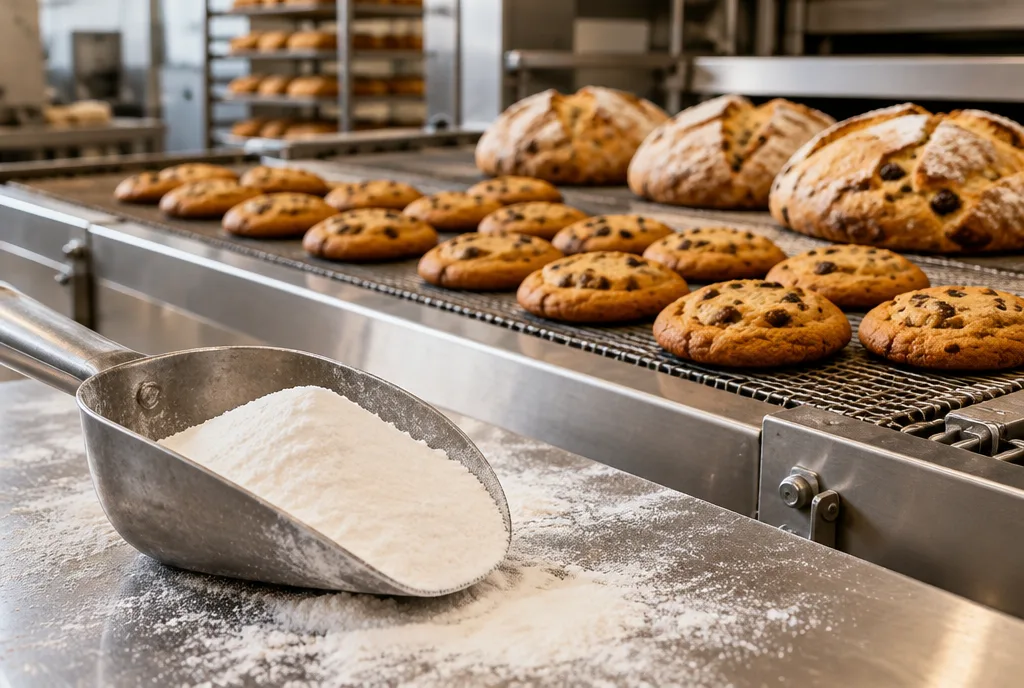
Sodium bicarbonate is one of the oldest and most important ingredients in baking. Cookies, crackers, cakes, gingerbread and soda bread all rely on it for volume, texture and colour. But not every grade behaves the same way in a dough. This article explains how sodium bicarbonate (E500(ii), CAS 144-55-8) works in bakery products, how to combine it with leavening acids, which particle size suits which application and what to look for when choosing a supplier.
Sodium bicarbonate (NaHCO3) releases carbon dioxide when it reacts with an acid in the presence of water. The gas forms small bubbles in the dough or batter, which expand during baking and give the product its volume and open crumb. The acid can come from the recipe itself – for example buttermilk, yoghurt, honey, cocoa or fruit – or from a leavening acid added on purpose.
Sodium bicarbonate also decomposes with heat alone. Without enough acid, however, sodium carbonate remains in the product. This leads to a soapy or bitter aftertaste, a yellowish crumb and excessive browning. That is why the ratio of bicarbonate to acid is so important.
In baking powders and bakery mixes, sodium bicarbonate is combined with one or more leavening acids. They differ mainly in how fast they release the gas:
The amount of acid needed is calculated with the neutralising value (NV) of the acid: it states how many parts of sodium bicarbonate are neutralised by 100 parts of the acid. A balanced ratio gives a neutral taste and a clean crumb colour.
The particle size of sodium bicarbonate influences how fast it dissolves and reacts:
Whatever the grade, consistent particle size from batch to batch is essential for reproducible volume and colour in industrial baking.
The same ingredient is also used in effervescent tablets and powders, in beverages, as an acidity regulator in food production and as a buffering agent in pharmaceutical products. For these applications, high purity and full documentation are just as important as in bakery.
biolla chemicals supplies food grade sodium bicarbonate E500(ii) in 25 kg bags to bakeries and food manufacturers across Europe. For baking mixes and coatings we also supply maltodextrin as a carrier and filler; for gingerbread and flat bakery products, ammonium bicarbonate (E503) is a common partner of sodium bicarbonate. Send us your quantity and delivery address via our contact form, by email to info@biolla.de or by phone on +49 40 67 555 155.