Delivery across Europe



Rita Brandes
Typically responds within a few minutes
Hey there...
How can we help you?

Sorbitol powder storage and handling guide: storage conditions, opened bags, incoming goods checks and documents to keep E420 free-flowing.

Sorbitol powder storage and handling decide whether your E420 arrives at the mixer as a free-flowing powder or as hard lumps. Sorbitol is a hygroscopic polyol: it readily takes up moisture from humid air. With a few simple rules in the warehouse and at the dispensing station, you keep the powder in the condition it had when the bag was sealed.
This guide is written for warehouse teams, production planners, QA and purchasing departments in food, confectionery and pharma companies. It covers storage conditions, handling of opened bags, incoming goods checks and the documents you should keep on file.
Sorbitol powder is valued for its clean sweet taste, its cooling effect and its good compressibility. The same property that makes sorbitol a useful humectant in food also means the powder interacts with the moisture around it. When humid air reaches the powder, the particle surfaces can become slightly sticky and form bridges between particles.
The result is caking: soft or hard lumps, poorer flow in hoppers and feeders, and dosing that is harder to control. Good storage prevents this and protects the quality of your finished products, from chewing gum and hard candy to chewable and compressed tablets.
Always follow the storage conditions stated on the specification and SDS for your batch. In practice, these general rules apply to sorbitol powder in 25 kg bags:
Humidity in a warehouse often changes with the season. Summer humidity and the transition periods in spring and autumn are critical. A simple hygrometer in the storage zone helps your team spot risky conditions early.
Most moisture problems do not start in the warehouse but at the point of use. These handling tips help keep sorbitol powder free-flowing during production:
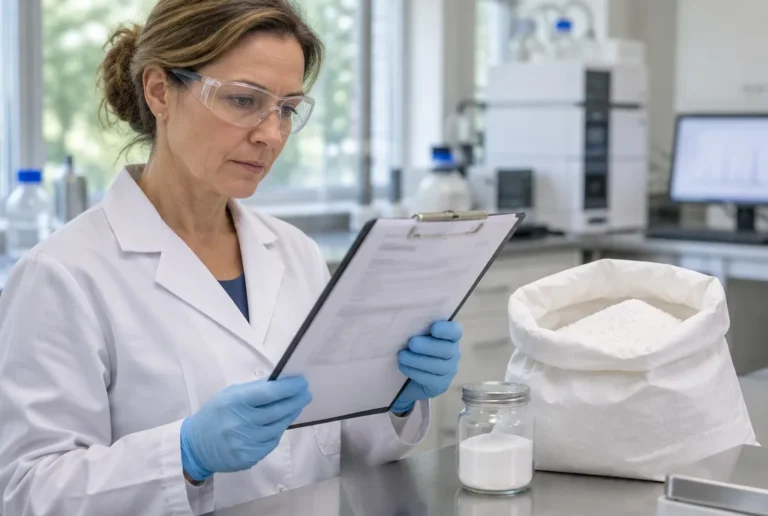
A short check at goods receipt helps you detect transport damage before material reaches production. Use this checklist:
| Check point | What to look for |
|---|---|
| Packaging | Intact bags, no tears, punctures or wet spots |
| Labelling | Product name, E420, batch number and dates match the delivery documents |
| Documents | CoA for the batch, matching the agreed specification |
| Pallet | Stable load, clean pallet, no signs of moisture |
| Appearance | On sampling: appearance as described in the specification |
Work with first-expired, first-out (FEFO) or first-in, first-out (FIFO) rotation, so older batches are used first. Record the batch number of every bag you use. This makes traceability simple if questions come up later in your own quality system.
Keep the specification, the Certificate of Analysis (CoA) for each batch and the Safety Data Sheet (SDS) on file. Your supplier should provide these documents on request.
Sorbitol is hygroscopic. When the powder is exposed to humid air or condensation, the particles can stick together and form lumps. Dry, stable storage and closed packaging prevent this.
Yes, if they are resealed tightly and kept in a dry area. Use opened bags as soon as possible and keep track of the batch number.
Yes. Sorbitol powder comes in 25 kg bags and must be protected from moisture. Sorbitol Solution 70% is a liquid supplied exclusively in IBCs of 1,100 kg and has its own handling requirements. You can read more about the powder’s applications in our article on sorbitol powder in chewing gum, confectionery and chewable tablets.
biolla chemicals is a Hamburg-based distributor of raw materials for the food and pharma industries. We supply Sorbitol Powder E420 in 25 kg bags and deliver across Europe from Hamburg. Specification, CoA and SDS are available on request, and samples can be arranged for your trials.
Find all details on the product page for Sorbitol Powder E420.
Related reading:
Get in touch with our team: